
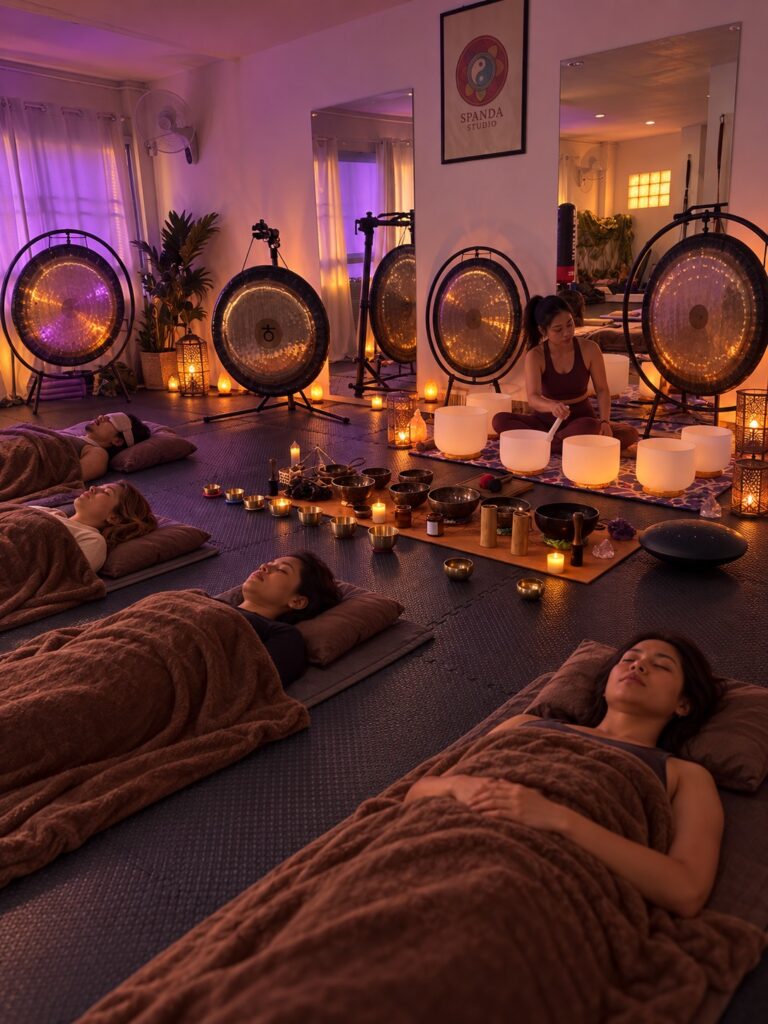
What vibration really does, what it may do—and why the popular “the body is water” explanation needs a closer look.
A gong is not only something we hear.
When it is played nearby, lower tones may also be felt through the floor, the air or the surface beneath the body. A singing bowl can create a subtle physical sensation as well as an audible tone.
That experience is real. The explanation, however, is often surrounded by claims that move much further than the evidence.
One of the most common is that the human body is mostly water, so sound vibrations travel through the water in our cells and “restore balance.”
It is an appealing image. It is also an oversimplification.
SOUND ENTERS THE EXPERIENCE IN MORE THAN ONE WAY
Sound is a mechanical pressure wave. When it reaches the ear, it is translated into neural signals that the brain interprets as pitch, loudness, rhythm and location.
From there, sound can influence attention, emotion, memory and arousal. A sudden unpredictable noise may make us alert. A slow, repeated and non-threatening sound may make it easier to settle.
This is not because one sound frequency automatically switches the brain into a predetermined state. It is because the brain continually evaluates patterns, context and meaning.
Vibration can also be experienced through touch.
Low-frequency sounds are more likely to produce a noticeable vibrotactile sensation, particularly when they are delivered through a surface that is in contact with the body. Specialised vibroacoustic devices use this principle by transmitting low-frequency sound through a chair, bed or mat.
A 2024 study involving 38 participants examined a 45-minute vibroacoustic sound massage delivered through a bed-like device. Researchers reported changes in heart-rate variability and electroencephalogram measures that were consistent with reduced arousal and increased parasympathetic activity. However, changes in self-reported wellbeing were not statistically significant, and the authors stressed that further research was needed. (pmc.ncbi.nlm.nih.gov)
This is interesting early evidence, but a vibroacoustic bed is not the same intervention as lying in a room while someone plays a gong or singing bowl.
DOES THE WATER IN THE BODY EXPLAIN THE EFFECT?
The adult body contains a substantial amount of water, but that water is not one open container.
It is held inside cells, blood, connective tissue and organs. These structures have different densities, boundaries and mechanical properties.
Sound and vibration can certainly travel through biological tissues. Medical ultrasound is one clear example. But it does not follow that the audible sound produced by a bowl reorganises or “resets” the water in the body.
At present, there is no good clinical evidence that a sound bath restores health by restructuring body water, clearing cellular memory or returning every organ to a natural frequency.
We can value the experience without turning a metaphor into biology.
WHAT ABOUT THE DENTAL-SCALER COMPARISON?
An ultrasonic dental scaler is a useful example of vibration transferring energy—but it is not a scientific model for a sound bath.
The scaler uses a rapidly oscillating metal tip in direct contact with, or extremely close to, the tooth. Water around the tip is moved forcefully, producing acoustic streaming and, under some conditions, microscopic cavitation. Together with the mechanical action of the tip, this helps disrupt deposits and biofilm. (pmc.ncbi.nlm.nih.gov, pmc.ncbi.nlm.nih.gov, pmc.ncbi.nlm.nih.gov)
The energy, frequency, intensity, distance and method of delivery are very different from those of a gong or singing bowl across a room.
In other words, both involve vibration, but they do not produce the same biological effect—just as sunlight and a surgical laser are both forms of electromagnetic energy but are not interchangeable.
WHAT MAY BE HAPPENING DURING A SOUND BATH
A sound bath combines several elements that may support relaxation.
The listener usually lies down in a safe, quiet environment. Visual input is reduced. Conversation stops. The sounds provide attention with a continuous object, making it easier to step away from planning, checking and problem-solving.
Slow changes in tone can also alter breathing naturally. As breathing becomes quieter and muscle activity decreases, the autonomic nervous system may begin to shift toward a calmer state.
A 2023 randomised study compared a Tibetan singing-bowl session with progressive muscle relaxation and a waiting condition. The singing-bowl group showed evidence of a short-term psychological and physiological relaxation response. The study was relatively small, however, and it does not establish a medical treatment or prove that every listener will respond in the same way. (pmc.ncbi.nlm.nih.gov)
A more recent systematic review found promising results for anxiety, sleep, mood and some physiological measures, while also noting major differences between studies and the need for better-quality trials. (pmc.ncbi.nlm.nih.gov)
The fairest conclusion is not that sound does nothing, nor that it possesses a proven ability to heal every system in the body. The evidence sits somewhere more interesting—and more honest—in between.
MYTH: EVERY ORGAN HAS A FREQUENCY THAT CAN BE “TUNED”
Everything with physical properties can have resonant behaviour under particular conditions. But the human body is not a collection of musical strings waiting to be tuned to one correct note.
Claims that a specific singing bowl frequency repairs a specific organ have not been established by good clinical evidence.
MYTH: A SOUND BATH FORCES THE BRAIN INTO THETA WAVES
Brain activity is complex. Several frequency patterns occur at the same time, and people do not all respond identically to the same sound.
Some small studies have reported changes in EEG activity during singing-bowl listening, but this does not justify guaranteeing a particular brainwave state.
FACT: CONTEXT IS PART OF THE EFFECT
The room, the facilitator, the pace of the session, the sense of safety and the permission to stop doing all contribute to the experience.
That does not make the benefit imaginary. It reminds us that human regulation is influenced by the whole environment, not simply by one frequency.
A sound bath may help because it gives attention somewhere gentle to rest. The vibration may add a physical dimension to the listening experience, particularly with large gongs and lower frequencies.
For many people, that is already meaningful.
We do not need to claim that sound reorganises the water in every cell. A quieter and more credible explanation is enough: sound can shape attention, influence arousal, support slower breathing and create a structured space in which the nervous system has fewer demands to answer.
Sometimes the most valuable part of sound is not that it changes the body through a mysterious force. It is that, for a while, it changes what the body is being asked to do.
SOURCES
Rio-Alamos C et al. “Acute Relaxation Response Induced by Tibetan Singing Bowl Sounds.” International Journal of Environmental Research and Public Health, 2023.
Fooks C and Niebuhr O. “Effects of Vibroacoustic Stimulation on Psychological, Physiological and Cognitive Stress.” 2024.
“Therapeutic Effects of Singing Bowls: A Systematic Review of Clinical Studies.” 2025.
Yu Y et al. “Cavitation in a Periodontal Pocket by an Ultrasonic Dental Scaler.” 2022.