
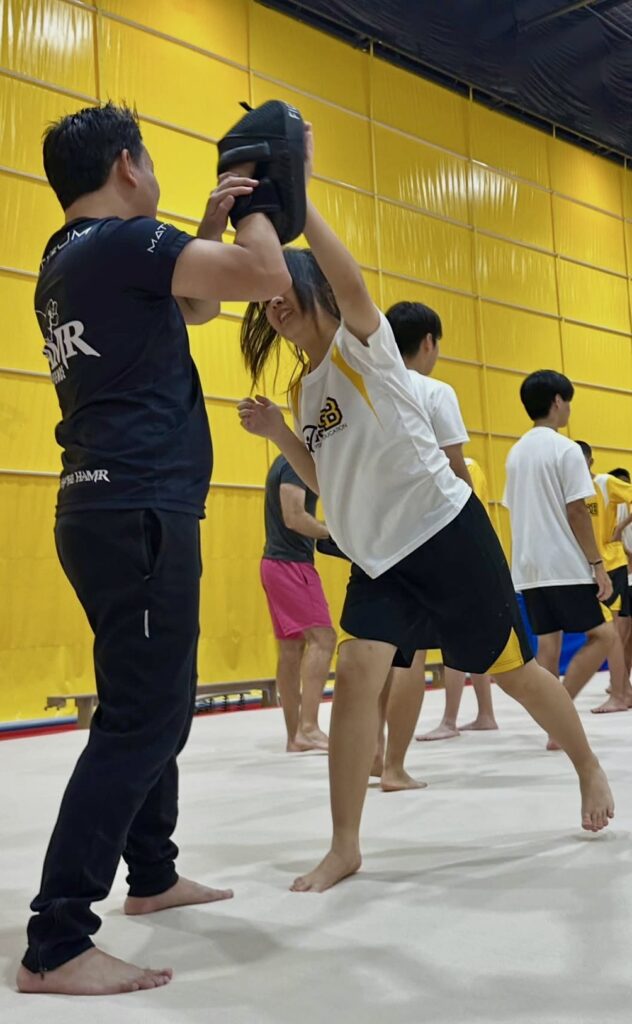
The Safety Skill Every University-Bound Student Should Practise
Why self-defence is less about fighting—and more about awareness, boundaries and giving the nervous system a plan.
By the final year of high school, families have prepared for almost everything.
There are university applications, visas, accommodation, bank accounts, healthcare arrangements and long conversations about living independently. Students learn to navigate new cities, manage deadlines and make decisions without a parent nearby.
But one form of preparation is often postponed or missed entirely: what to do when an ordinary situation begins to feel wrong.
For students leaving the familiarity of an international-school community, university life may bring unfamiliar transport systems, social environments, campuses and living arrangements. Parents cannot anticipate every situation their children will encounter. What they can do is help them develop the awareness, language and practised responses to recognise when something has changed—and act earlier.
This is where responsible self-defence education becomes valuable.
It should not make teenagers frightened of the world. Done well, it should help them move through it with greater confidence.

THE MOMENT WE CANNOT PLAN FOR
Most of us imagine that if something threatening happened, we would react decisively. We would move away, call for help or say exactly the right thing.
The nervous system does not always follow that script.
When the brain detects a possible threat, the body can begin responding before the conscious mind has fully understood what is happening. Breathing may change. Muscles may tighten. Attention may narrow. Some people feel an immediate urge to leave, while others become confrontational or unusually still.
We usually describe this as “fight or flight,” but freezing is also a normal part of the human defence system.
Research suggests that an initial freeze response may briefly reduce movement while attention focuses on the potential threat. In some circumstances, this can be part of preparing for action. When fear is extreme or escape feels impossible, a more profound involuntary immobility response may occur. (pmc.ncbi.nlm.nih.gov, pmc.ncbi.nlm.nih.gov, pmc.ncbi.nlm.nih.gov)
Freezing is not weakness, cowardice or consent. It is a nervous-system response.
Understanding this before a difficult situation matters. People often assume that confidence will make them immune to fear. When their body reacts differently from what they imagined, they may feel confused or blame themselves afterwards.
Good self-defence training does not pretend that fear can be switched off. It teaches people how the body may react—and gives thon. Students learn how to apply to university, manage deadlines, organise travel and live more independently.
Yet one form of preparation is often left until the last minute: knowing how to respond when a situation suddenly feels wrong.
This matters particularly for students moving abroad. They may be navigating unfamiliar transport, social situations, campuses and accommodation without the routines and support systems they have known at home.
Self-defence education should not make young people frightened of the world. Done responsibly, it should do the opposite. It should help them recognise choices earlier, communicate boundaries more clearly and respond with greater confidence.
THE BODY REACTS BEFORE WE FINISH THINKING
In a threatening or confusing situation, the nervous system begins assessing information before the conscious mind has constructed a complete explanation.
Changes may occur in heart rate, breathing, muscle tension, attention and perception. Some people feel an immediate urge to move away. Others become confrontational. Some become unusually still.
We often reduce these reactions to “fight or flight,” but the human defence system is more complex. Freezing is also a natural response.
Research suggests that an initial freeze response can temporarily reduce movement while attention becomes highly focused on the possible threat. In some circumstances, this may help the brain gather information and prepare for action. Under extreme fear or when escape feels impossible, a person may experience a more profound involuntary immobility response. (pmc.ncbi.nlm.nih.gov, pmc.ncbi.nlm.nih.gov, pmc.ncbi.nlm.nih.gov)
Freezing is not cowardice, weakness or consent. It is a nervous-system response.
That distinction matters because people often imagine that they will automatically shout, run or fight back. When their actual response is different, they may blame themselves afterwards.
Good self-defence training acknowledges biology instead of pretending fear can be eliminated.
TRAINING CREATES A FAMILIAR PATH
Training cannot guarantee that someone will respond in one particular way. Real situations are unpredictable, and personal safety is never entirely under one person’s control.
What training can do is make certain decisions less unfamiliar.
If someone has practised noticing a boundary violation, using a clear voice, moving toward an exit and asking directly for help, those actions are no longer completely new.
This is one reason realistic repetition matters. The purpose is not to create aggression. It is to reduce the number of decisions the brain must invent under pressure.
Training may also help people recognise that self-defence begins well before physical contact. It includes noticing changes in the environment, taking discomfort seriously, communicating boundaries and leaving when a situation begins to feel unsafe.
SITUATIONAL AWARENESS IS NOT HYPERVIGILANCE
Being aware does not mean scanning every room in fear or treating every stranger as a threat.
Healthy situational awareness is calmer than that. It means remaining connected to what is happening around you instead of becoming completely absorbed in a phone, conversation or internal worry.
It may involve noticing where the exits are, how you will travel home, whether a friend knows your plans and whether someone is repeatedly ignoring a clearly stated boundary.
It also means recognising transition points, such as leaving a social event, entering an unfamiliar vehicle or walking from a bright public area into a quiet one.
The aim is not to predict every possible danger. It is to notice when the situation changes and give yourself permission to respond before you have collected enough evidence to satisfy everyone else.
WHAT RESEARCH TELLS US
One of the best-known studies in this field involved 893 first-year female university students in Canada.
Participants in the Enhanced Assess, Acknowledge, Act programme learned to assess risk, recognise barriers to acknowledging danger and practise verbal and physical resistance. After one year, the risk of completed rape was 5.2% in the training group, compared with 9.8% in the control group—a relative reduction of 46%. The risk of attempted rape was also lower. (nejm.org, pubmed.ncbi.nlm.nih.gov, pmc.ncbi.nlm.nih.gov)
This does not mean a course can prevent every assault, nor does it place responsibility on the person targeted. Responsibility always belongs to the person who chooses to violate another person’s boundaries.
It does show that carefully designed, empowerment-based education can make a meaningful difference. Current CDC prevention guidance includes empowerment-based training alongside healthy relationship education, bystander approaches and the creation of safer environments. (cdc.gov)
Self-defence should therefore be one part of a broader safety culture—not a substitute for institutional responsibility, appropriate security, supportive friends or respectful social norms.
MYTH: SELF-DEFENCE IS MAINLY ABOUT WINNING A FIGHT
The safest outcome is usually not “winning.” It is creating an opportunity to leave, reach other people or attract help.
Physical techniques are only one part of the training. Awareness, voice, boundaries, judgement and movement are often introduced first because they may create options before a situation becomes physical.
MYTH: CONFIDENT PEOPLE DO NOT FREEZE
Confidence does not switch off the nervous system. Trained people can still experience fear, surprise or freezing.
The difference is that practice may give the brain more familiar actions to draw upon after that first moment of shock.
FACT: BOUNDARY PRACTICE BELONGS IN SELF-DEFENCE
Many uncomfortable situations do not begin with an obvious attack. They begin with pressure, testing, unwanted closeness or the repeated dismissal of a small “no.”
Practising direct language and learning that politeness is not more important than safety can be as valuable as practising a physical movement.
A LIFE SKILL, NOT A REASON TO LIVE IN FEAR
The purpose of self-defence education is not to convince young people that danger is everywhere. It is to help them move through the world with greater awareness and a wider range of choices.
For students preparing to leave school, this is as practical as learning to manage money, travel alone or ask for help.
And it is not only a lesson for teenagers. Adults also benefit from revisiting how they respond to discomfort, how clearly they communicate boundaries and whether they trust themselves to leave a situation that no longer feels right.
Real confidence is not the belief that nothing difficult will happen. It is knowing that you have practised what to do next.
SOURCES
Senn CY et al. “Efficacy of a Sexual Assault Resistance Program for University Women.” New England Journal of Medicine, 2015.
Senn CY et al. “Secondary and Two-Year Outcomes of a Sexual Assault Resistance Program for University Women.” Psychology of Women Quarterly, 2017.
Roelofs K. “Freeze for Action: Neurobiological Mechanisms in Animal and Human Freezing.” Philosophical Transactions of the Royal Society B, 2017.
US Centers for Disease Control and Prevention. “Preventing Sexual Violence,” updated 2024.