
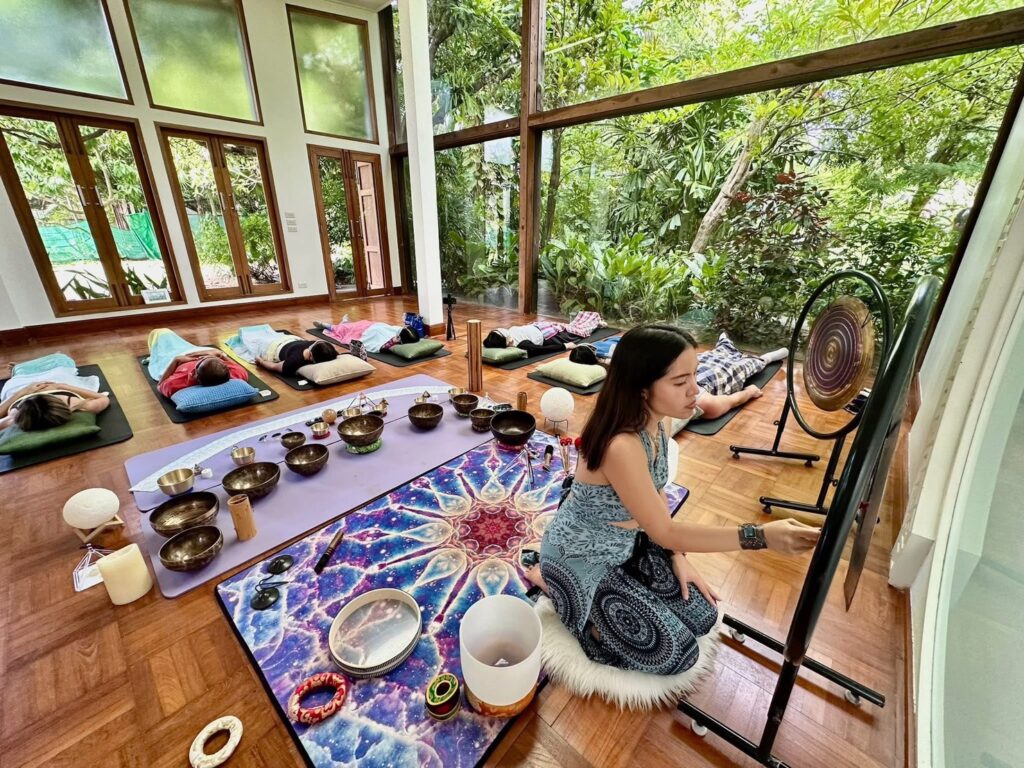
A sound bath may appear simple: lying still, listening to sound.
Yet inside the brain, measurable changes can occur.
In everyday life, the brain is often dominated by beta brainwaves, which are associated with thinking, planning, and alertness. Even during rest, many people remain in this active state.
Sustained, rhythmic sounds — such as those produced by singing bowls or gongs — can encourage the brain to shift into alpha brainwave activity. Alpha states are linked to relaxation, calm awareness, and reduced mental noise. This is often when people begin to feel settled or grounded.
With continued exposure, some individuals move into theta brainwaves, commonly observed in meditation and the moments just before sleep. Theta activity is associated with deep relaxation, emotional processing, and memory integration. This may explain why sound baths sometimes bring up imagery, emotions, or a sense of timelessness.
In certain moments, especially when the nervous system feels safe, brief periods of delta brainwave activity may occur. Delta waves are most commonly present during deep sleep and are associated with physical restoration and nervous system recovery. Even short episodes of delta activity are considered beneficial for rest and repair.
Neuroscience describes this process as neural entrainment — the brain’s natural tendency to synchronize with steady, repetitive sensory input. Importantly, this response does not require concentration or belief; it is a passive physiological process.
At SPANDA, sound baths are offered simply as a space where the brain and nervous system are allowed to slow down — without effort, expectation, or performance.
Sometimes, rest begins when the brain is given permission to be quiet.
Short Science References
• Goldsby et al., Journal of Evidence-Based Integrative Medicine — Effects of Singing Bowl Sound Meditation
• National Institutes of Health (NIH) — Brainwave states and the relaxation response
• Harvard Medical School — Neural entrainment and stress reduction